





















Click to jump to the text

JAPAN

Japan is situated in northeastern Asia between the North Pacific and the Sea of Japan. The area of Japan is 377,873 square kilometers, nearly equivalent to Germany and Switzerland combined or slightly smaller than California. Japan consists of four major islands, surrounded by more than 4,000 smaller islands.

日本語 English
繁體中文 한국어

JNTO TRAVEL PLANNER

Before using the Planner, read the following items to help make your sightseeing trip safe and enjoyable.

Usage Guide

KIE

MATSURI

Featured Articles

  1. Home >
  2. Japan In-Depth  >
  3. Featured Articles >
  4. KIE >
  5. MATSURI
Text starts here.

Kateigaho International Edition

Kumano

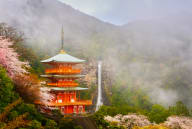
The Nachi virgin forest surrounds the waterfall. Here in the Kumano area of the Kii Peninsula mystical traditions arose from ancient people's awe of nature. When they emerged from the dense forest to see the waterfall gushing like a white streak from the heavens, what else could they feel?

Along the path lies the waroda stone carved with three Sanskrit letters. These symbolize the gods of Kumano's three main mountains: Amida of Hongu Taisha, Yakushi of Hayatama Taisha, and Kannon of Nachi Taisha. It's said the three gods met atop this stone (date unknown).

Sections of the path linking Nachi and Hongu shrines are the steepest. Lore held that at one point on the path one might be bewitched by spirits of those who had died of hunger along the way. Edo-period natural historian Kumagusu Minakata believed he was bewitched.

Dotting the path are ancient mossy Jizo carvings, placed there through the centuries to honor those who have died and to protect travelers en route. The left hand holds the Jewel of Truth to shed light and hope, while the right hand holds a pilgrim's staff.

Many forests are rich in natural beauty, but if one is seeking supernatural spirit, Kumano tops the list. Stretching across the Kii Peninsula in Wakayama prefecture, it has peaks and valleys lined up one after another like waves billowing across the sea. This area of remote mountains was a pilgrimage route from the Heian period (794-1192) through the Edo period (1603-1867). Commoners and emperors alike came to its three great shrines. Now a UNESCO World Heritage Site, it is still used by ascetics for spiritual practice. In the Heian period, these mountains and forests were considered the Pure Land of Buddhism, therefore sacred. Today the hills are largely covered with Japanese cedar plantations, but in antiquity the glossy-leafed temperate forest was dark and deep and full of spiritual feeling. Even now mossy stone walls and ancient Jizo carvings line the old winding path. There is a feeling of awe toward something invisible, and at the same time the simple thought of one's tiny existence within it all. One could say Japan's sense of nature is completely summed up by this feeling. These forests gave birth to writers Kumagusu Minakata, Haruo Sato, and Kenji Nakagami. These are forests that stir the imagination.

Kumano Kodo, the pilgrimage route linking the three main shrines, covers about 500 kilometers. The still-maintained parts received World Heritage status. The section paved with flagstones is a good one-day hike route. The part through the Omine Mountains is winding and steep, used by ascetics, and off limits to women.

photography by Yasunobu Kobayashi
text by Editorial Staff
map by Yoshifumi Furuhashi
translation by Alex Kerr


(C) Kateigaho International Edition All Right Reserved.Top